


If you can only pick one route, which should it be?
The Camino Francés. Not because it’s the prettiest, but because it’s the easiest to manage on the ground:
- Services are closest together. Villages are usually just a few kilometers apart, so if you run out of steam, it’s easy to find a bed a little earlier or a little further on.
- Most sociable. Even if you start solo, you’ll meet fellow pilgrims on day one, and the waymarking is the clearest of any route.
- Huge variety of scenery. Over roughly 763 km, you’ll cross the Pyrenees, walk through wine country and across the Meseta, and finally enter rainy, lush green Galicia.
How many days do you have? Three ways to walk
Decide how many days you have first, and your starting point will virtually pick itself. The distances below are the walking distances to Santiago in CaminoGO’s route data, and the stage counts are the app’s default stages before adding rest days.
5+ weeks: Walk the full route from Saint-Jean-Pied-de-Port. Roughly 763 km over 34 stages; add 2–4 rest days for a total of about 36–38 days.
2–3 weeks: Start from León, Ponferrada, or Porto.
- Camino Francés from León: approx. 304 km, 13 stages
- Camino Francés from Ponferrada: approx. 205 km, 9 stages
- Portuguese Way from Porto (Central): approx. 241 km, 11 stages
- Portuguese Coastal Way from Porto: approx. 272 km, about 12 days
Around 1 week: Walk the last 100+ km.
- Camino Francés from Sarria: approx. 115 km, 5 stages
- Portuguese Way from Tui: approx. 120 km, 6 stages
- English Way from Ferrol: approx. 112 km, 6 stages
Who are the other routes for?
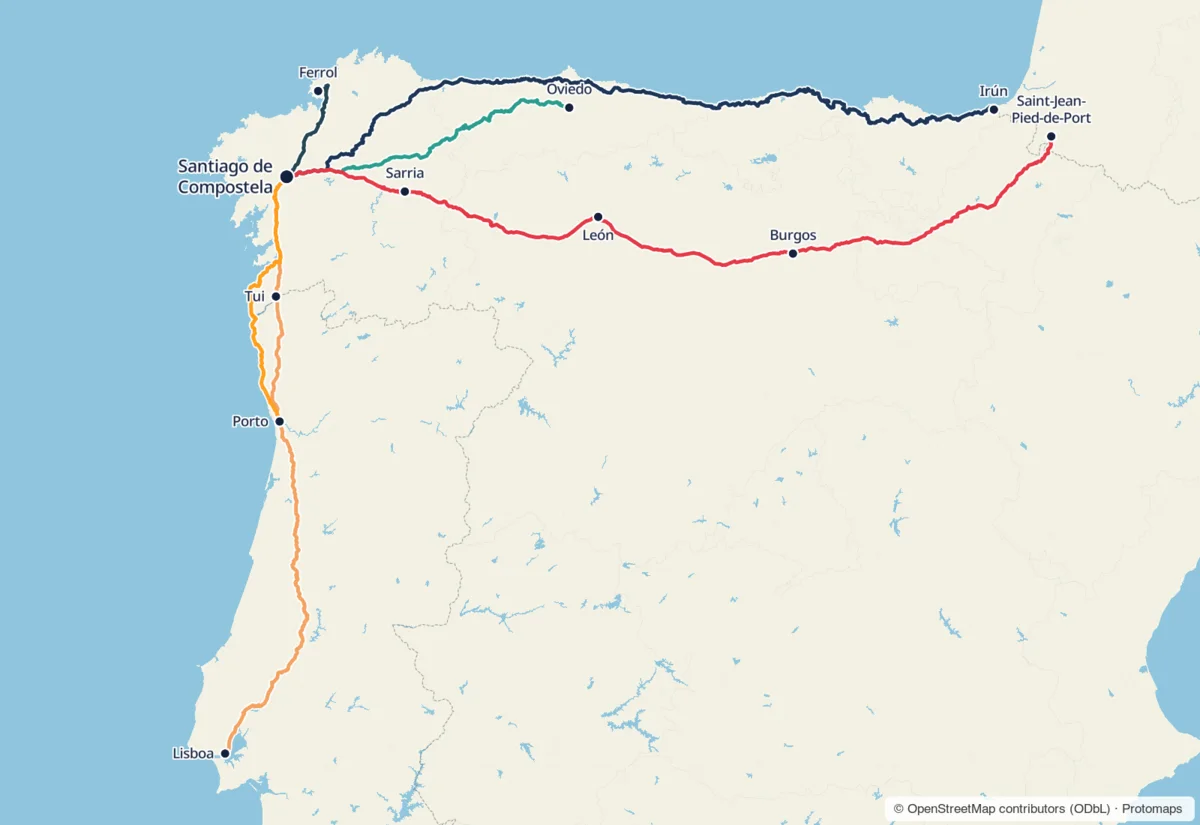
In brackets: starting point, distance, and difficulty rating in CaminoGO.
- Portuguese Way (Porto, approx. 241 km, Moderate): Best if you have around two weeks and want fewer hills.
- Portuguese Coastal Way (Porto, approx. 272 km, Easy): Best if you want ocean views along the way and the gentlest gradients.
- Camino del Norte (Irún, approx. 844 km, Hard): Best if you have long-distance hiking experience, want to avoid crowds, and don’t mind daily climbs and descents.
- Camino Primitivo (Oviedo, approx. 313 km, Hard): Mountainous with dramatic scenery, traditionally considered one of the earliest pilgrim routes.
- English Way (Ferrol, approx. 112 km, Easy): A complete route from start to finish that you can walk within a week.
Are there starting-point rules if you want a Compostela?
Yes: you must walk at least 100 continuous kilometers on the same route, and your final stage must walk into Santiago. All three of the “1 week” starting points above sit just beyond that mark. If you start the English Way from A Coruña, it’s only about 73 km, so you’ll need to walk a recognized route outside Spain beforehand to qualify. For full details, see The Compostela and other certificates: requirements and where to get them.
Key points
- First time and can’t decide? Pick the Camino Francés.
- Let your timeframe set your start: 5 weeks for the full route, 2–3 weeks from León or Porto, 1 week from Sarria or Tui.
- Your starting point must be at least 100 km from Santiago to qualify for a Compostela.
In CaminoGO
When you use “Create trip” and pick your route, starting point, and destination, the app calculates the total distance and days using default stages; change your start to Sarria or Porto and the day count updates automatically. Next up, read How many kilometers a day? How to plan your stages.
Sources
- Oficina del Peregrino:The Compostela (checked 2026-10-16)
- 加利西亞自治區政府新聞稿(2026-02-06):2025 年發出 530,987 張 Compostela (checked 2026-10-16)
- 地圖資料:© OpenStreetMap 貢獻者(ODbL);底圖 Protomaps;路線:CaminoGO 路線資料 (checked 2026-10-16)
- 照片:聖地牙哥座堂,Antoine Cadotte,CC BY-SA 3.0(Wikimedia Commons) (checked 2026-10-16)
Walk it with CaminoGO
Offline maps, a plan that fits your pace, changes on the way, and a daily walk log with passport stamps — all in the app.
Get the app