

How far should you walk each day?
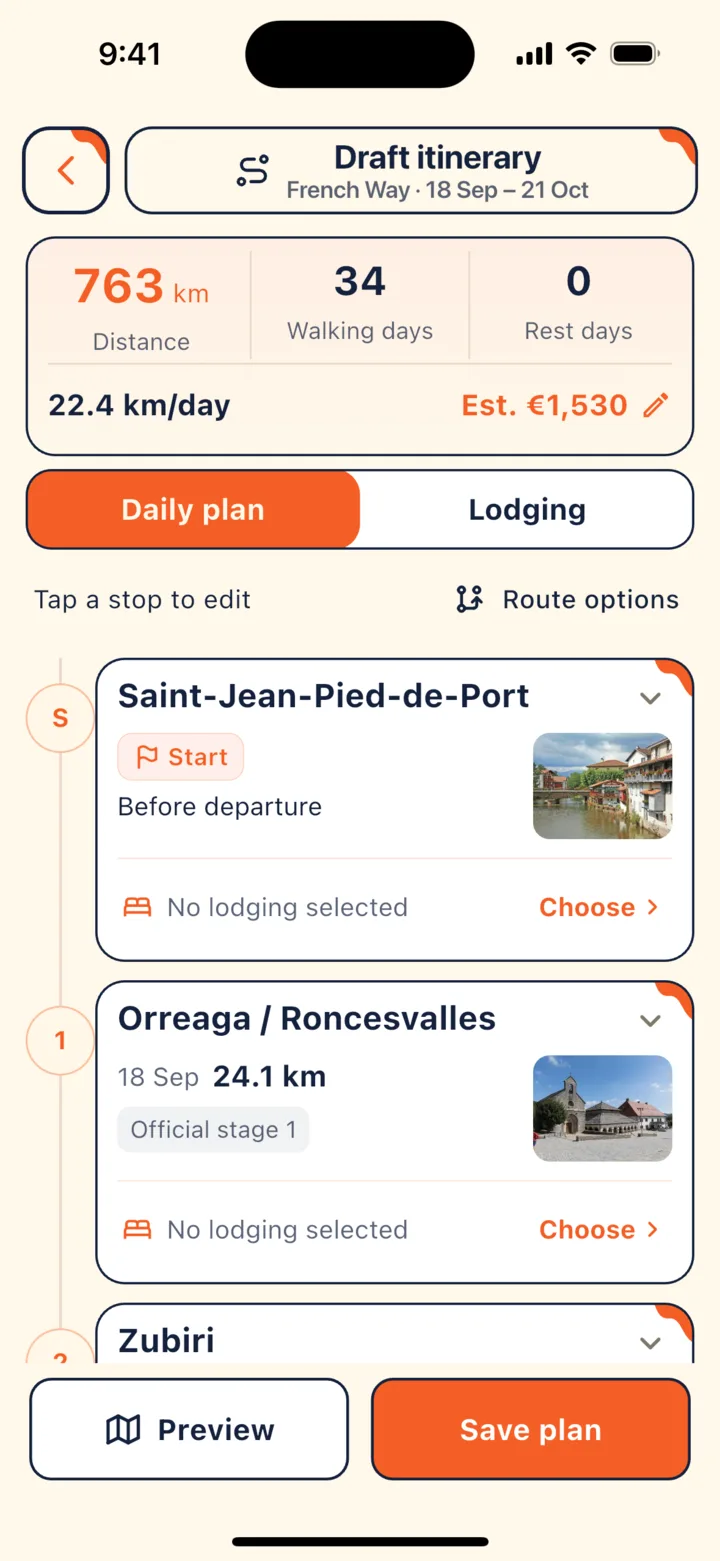
20–25 km. That is the most comfortable range for most people. On the Camino Francés, for example, CaminoGO divides the roughly 763 km route into 34 stages, averaging about 22 km per stage—the shortest is around 18 km, and the longest is around 32 km.
How long does it take to walk 22 km?
About 5–7 hours.
- On flat ground, you walk about 4–5 km per hour.
- Stops for rest, breakfast, and photos usually add another 1–2 hours.
- Climbs slow you down noticeably. A common rule of thumb: add 1 hour for every 600 m of elevation gain.
Many people set out around 7:00 AM and arrive just after noon. You spend the afternoon doing laundry, resting, and exploring the town, and you're in bed before 10:00 PM.
What is the terrain like along the Camino Francés?
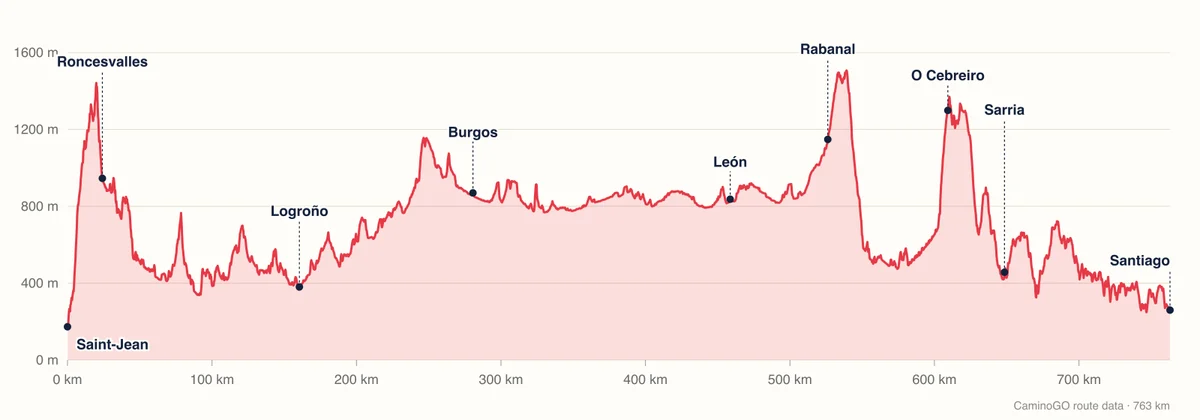
Big mountains at the start and end, with a long high plateau in the middle. On day one you cross the Pyrenees; between Burgos and León lies the relatively flat Meseta at around 800 m above sea level; after León, you have two more mountain climbs: topping out at around 1,500 m after Rabanal, followed by O Cebreiro at around 1,300 m.
Is the first day really that tough?
Day one of the Camino Francés is the hardest day of the entire route. From Saint-Jean-Pied-de-Port to Roncesvalles is about 24 km with roughly 1,450 m of cumulative elevation gain—more than any stage that follows.

How far should you walk in the first few days?
A little less than average. It takes your body about 3–4 days to get used to walking every day with a pack. Walking a few kilometers less in the first few days greatly reduces your chances of blisters, knee pain, and tight calves later on. Official advice from Galicia says the same: plan your stages around your own fitness and goals.
How do you choose where to end each stage?
Look at four things: lodging, elevation gain, resupply points, and daylight.
- Make sure there is lodging at the end. Check first that the village or town has an albergue or hotel, and pay extra attention to bed availability in peak season.
- Look at elevation gain, not just distance. Twenty kilometers on flat ground is very different from twenty kilometers over a mountain.
- Check the gaps between resupply points. The Meseta (roughly between Burgos and León), for instance, is flat, but some villages are far apart and summer is hot and exposed—plan ahead where you will refill your water.
- Arrive before dark. Waymarks are designed for daytime walking, and Galician authorities also advise against walking at night.
How many rest days should you plan?
Take one rest day every 7–10 walking days. Larger cities work best, such as Pamplona, Burgos, and León on the Camino Francés: you can do laundry, replace gear, and take your time exploring.
Key points
- Walking 20–25 km (5–7 hours) a day is the sweet spot for most people.
- Walk a little less for the first three or four days, and take a rest day every 7–10 days.
- Choose your stage endpoints based on four things: lodging, elevation gain, resupply points, and arriving before dark.
In CaminoGO
When setting up your trip, select “Your pace” to decide roughly how far you want to walk each day; tap “Generate draft itinerary” and the app lays out your daily overnight towns. You can adjust any day afterward—change the overnight town or add rest days. Drag your finger left or right across each day's elevation profile to see the exact distance and altitude at any point.
Sources
- 加利西亞官方聖雅各之路網站:Advice and recommendations (checked 2026-10-16)
- 照片:Roncesvalles,A1AA1A,CC BY-SA 4.0(Wikimedia Commons) (checked 2026-10-16)
Walk it with CaminoGO
Offline maps, a plan that fits your pace, changes on the way, and a daily walk log with passport stamps — all in the app.
Get the app